RESTORATION, PRESERVATION & ARCHIVING
MENU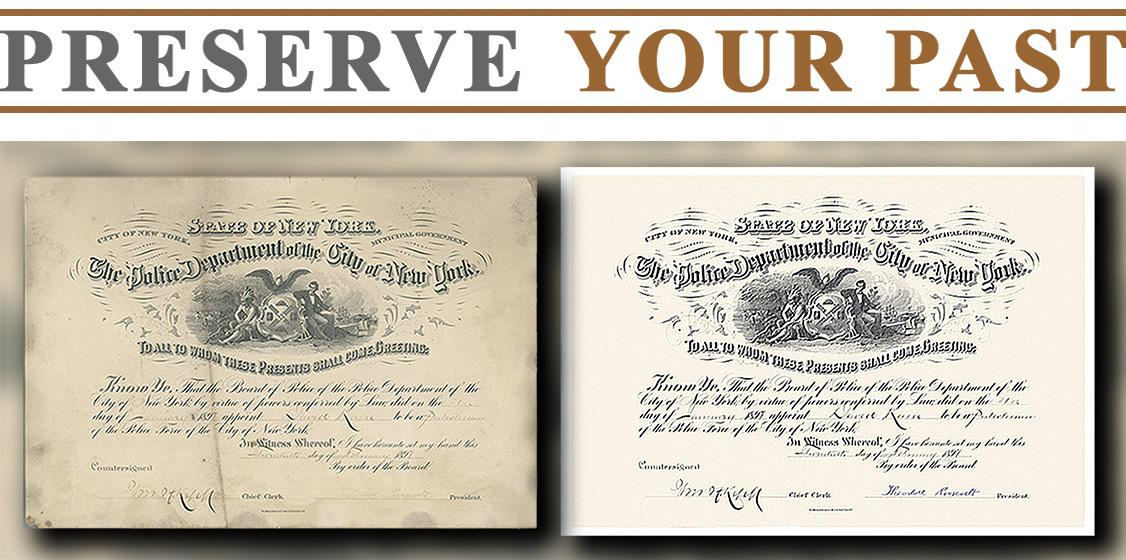
From a Family Archive to a Piece of American History
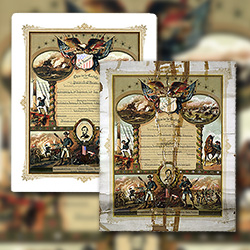
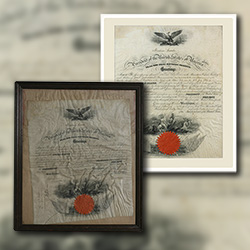
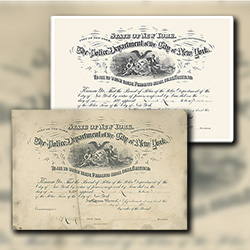
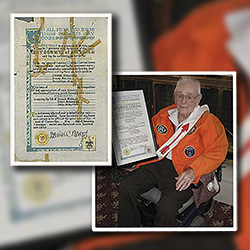
A historic New York Police Department appointment certificate bearing the signature of future U.S. President Theodore Roosevelt arrived at the restoration studio in a state of severe deterioration. The fragile document had been glued onto cardboard, causing extensive warping, discoloration, and surface damage. Decades of exposure had caused the paper to become heavily yellowed and brittle, while the handwritten signatures - including Roosevelt’s, had faded to the point of being barely recognizable.
The first stage of the restoration process involved carefully removing surface dirt and stabilizing the fragile paper fibers. The document was gently cleaned, deacidified, and treated to reduce the risk of further deterioration. Because the original certificate had suffered irreversible damage, a high-resolution digital restoration was created to preserve and present the document in a form that revealed details previously hidden by age and degradation.
Through careful digital reconstruction, stains, discoloration, tears, and other visual distractions were removed while preserving the historical character of the original artifact. The faded handwriting and Theodore Roosevelt’s signature were enhanced, allowing the document’s important historical details to become visible once again.
The client discovered the document among family archives, where it had survived for more than a century. Originally issued to appoint an ancestor as a member of the New York City Police Department, the certificate documented both an individual’s beginning in public service and a significant moment in Roosevelt’s early political career.
Despite extensive damage, including tears, fading, darkened paper, and severe loss of readability, the document was carefully preserved and digitally restored, allowing future generations to appreciate its historical importance.
A thank you letter from the client:
What a wonderful job you done on the restoration of the 110 year old certificate we recently located in our family archives. The certificate was signed by future US President Theodore Roosevelt when he was Commissioner of the New York City Police Department. The purpose of the certificate was to appoint our ancestor as member of the Department.
In 1897, our ancestor was a recent immigrant to the United States. The certificate was torn, faded, darkened and carried just about every impediment to legibility which one could imagine. However, you proceeded diligently and with care to rejuvenate this 1897 document into nearly good as new condition. It was a pleasure to work with you.
Very truly yours,
- David
The restored certificate represents more than an official appointment document - it is a personal connection between a New York immigrant family and one of the most influential figures in American history.
At the end of 19th century, the NYPD was widely criticized for political influence, corruption, and a lack of professional standards. Police appointments were often controlled by powerful political figures, particularly through the city’s political machine, and positions could sometimes be obtained through patronage rather than qualifications.
Roosevelt approached the position with the same energy and determination that would later define his presidency. He believed that public institutions should serve citizens rather than political interests, and he began a sweeping campaign to modernize the department. Working alongside journalists and reform advocates such as Jacob Riis and Lincoln Steffens, Roosevelt pushed for professional standards, accountability, and greater efficiency within the police force.
One of Roosevelt’s major reforms was replacing political favoritism with a merit-based system for appointments and promotions. He introduced stricter hiring standards, improved police discipline, expanded training requirements, and emphasized honesty and character as essential qualities for officers. These reforms helped move the NYPD toward becoming a modern professional law enforcement organization.
During his tenure, Roosevelt also addressed corruption within the department, strengthened enforcement against illegal activities, and promoted greater transparency. He famously conducted surprise inspections of police stations, often at night, to ensure that officers were properly performing their duties.
Roosevelt’s administration also marked important steps toward greater inclusion within the department. In 1896, he appointed Isabella Goodwin as the NYPD’s first female detective. Her appointment represented a significant change in an era when police work was almost exclusively viewed as a male profession.
 Although Theodore Roosevelt’s tenure as New York City Police Commissioner lasted less than two years, the principles he championed, professionalism, accountability, and reform, defined his later political career and presidency. After leaving New York, Roosevelt rose rapidly through national politics, becoming Vice President in 1901 and assuming the presidency after the assassination of President William McKinley.
As President from 1901 to 1909, Roosevelt became one of the most influential leaders of the Progressive Era. He believed that government had a responsibility to protect ordinary citizens, regulate powerful corporations, preserve the nation’s natural resources, and strengthen America’s role on the world stage.
One of Roosevelt’s greatest domestic achievements was his commitment to conservation and the protection of America’s wilderness. During his presidency, he dramatically expanded the federal government’s role in protecting natural resources, establishing 51 federal bird reserves, 150 national forests, five national parks, and 18 national monuments. His conservation efforts protected approximately 230 million acres of public land and helped create the foundation of the modern American conservation movement. Among the lands preserved during his administration were areas that would later become some of the nation’s most treasured natural landmarks.
Roosevelt also played a major role in the construction of the Panama Canal, one of the most ambitious engineering projects in modern history. Recognizing the strategic and economic importance of a canal connecting the Atlantic and Pacific Oceans, his administration supported Panama’s independence movement from Colombia and negotiated an agreement allowing the United States to construct and control the canal zone. Completed in 1914, the Panama Canal transformed global shipping and significantly strengthened American naval and commercial power.
On the international stage, Roosevelt established the United States as a major world power. During the Russo-Japanese War (1904–1905), he acted as a mediator between Russia and Japan, helping negotiate the Treaty of Portsmouth that ended the conflict. For his diplomatic efforts, Roosevelt became the first American to receive the Nobel Peace Prize in 1906, recognizing his role in promoting a peaceful resolution to the war.
 Roosevelt also sought to improve the federal government’s relationship with Native American communities and supported efforts to protect Native American land rights in certain cases, appointed Native Americans to federal positions, and invited Native American leaders to the White House. In 1906, he signed the Burke Act amendments and other measures affecting Native land administration, while also advocating for greater fairness in government treatment. His record reflected both reform-minded efforts and the complicated legacy of federal Native American policy during the early 20th century.
Through his police reforms in New York, his Progressive Era legislation, conservation achievements, diplomatic accomplishments, and expansion of America’s role in global affairs, Theodore Roosevelt left a lasting mark on the United States. The signature preserved on this restored NYPD appointment certificate represents a rare connection to the early career of a leader whose influence extended far beyond New York City.
Unfortunately, all of his accomplishments and efforts did not resonate with the hearts and minds of later leaders in New York's government and cultural establishment. In 2022, Theodore Roosevelt's statue was removed from the American Museum of Natural History and relocated to the Presidential Library in Medora, North Dakota, in a decision that many viewed as a victory for cancel culture and a blow to history.
|
|
|
|

|
|
|
|
|
|
|
|
|
|
|
|
|
|
|
|
|
|
|
|
|
|
|
|
|
|
|
|
|
|
|
|
|
|
|
|
|
|
|
|
|
|
|||||||||
| © 2026 Preserve Your Past | |||||||||
| By accessing this website you signify that you read, understood, and agreed to be bound by Terms of Services. If you do not agree to these terms, you are not permitted to use the Services. These Terms of Services have the same force and effect as an agreement in writing. |
|||||||||


