RESTORATION, PRESERVATION & ARCHIVING
MENU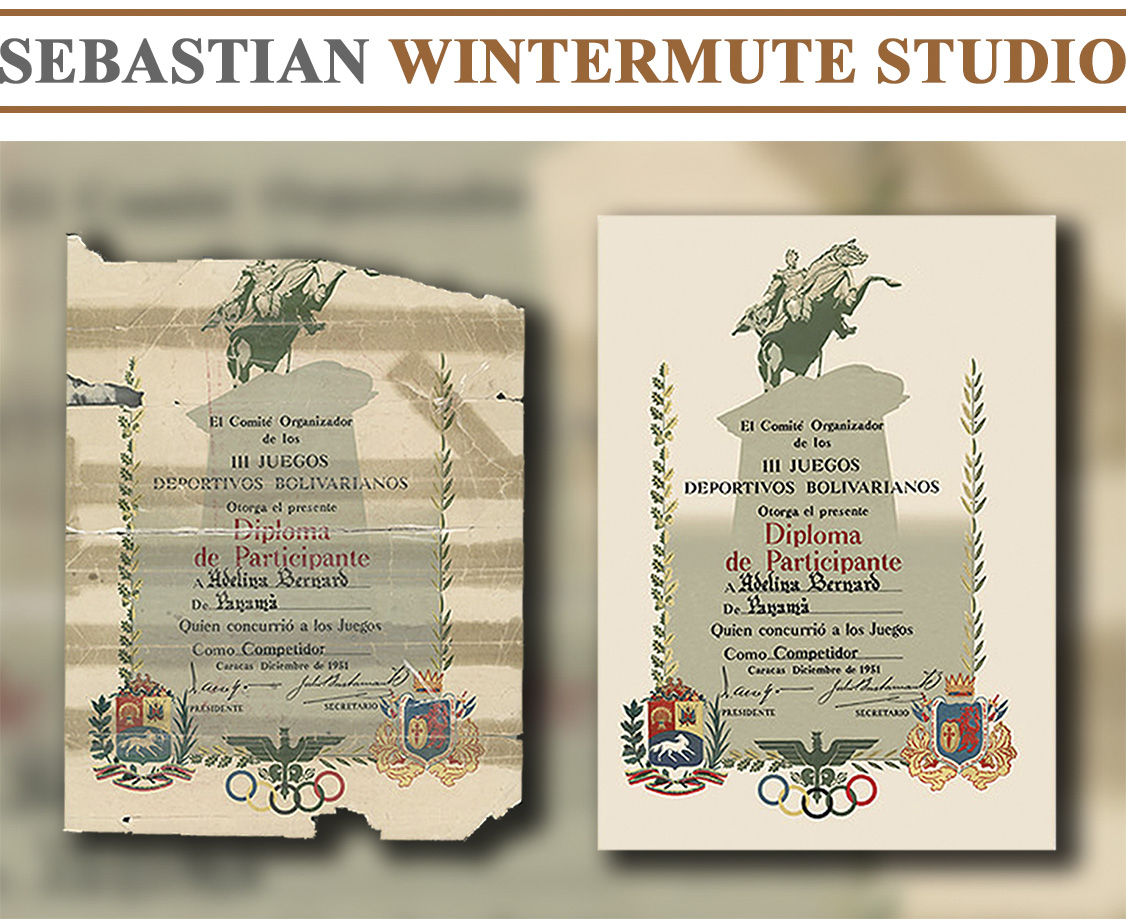
RESTORATION OF A 1951 BOLIVARIAN GAMES AWARD POSTER
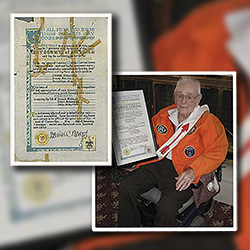
An award poster from the 1951 Bolivarian Games is a wonderful example of how even a severely damaged historical document can sometimes be brought back to life with the help of modern technology and careful restoration.
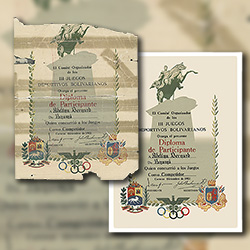
At first glance, the original appeared to be in very poor condition. Years of repeated folding had caused the paper to split and tear along the creases. At some point, someone attempted to repair the damage with clear adhesive tape, connecting the separated pieces and holding the document together. Unfortunately, rather than preserving the poster, the aging adhesive caused additional chemical damage. Over time, the adhesive penetrated into the paper, leaving behind extensive stains and discoloration.
To make matters even more difficult, a substantial section along the top of the document was completely missing. The result was a fragile and heavily damaged piece of sporting history that could no longer be properly displayed in its original condition. Yet beneath the tears, stains, and missing sections, the document still retained its historical importance and much of its original visual character.
 The Bolivarian Games take their name from Simón Bolívar, the Venezuelan military and political leader who played a central role in the independence movements that freed much of northern and western South America from Spanish colonial rule during the early 19th century.
Bolívar is remembered as one of the most influential figures in the history of Latin American independence. His military and political campaigns contributed to the liberation of territories that became the modern nations of Venezuela, Colombia, Ecuador, Peru, and Bolivia. His legacy is also closely connected to the history of Panama, which was part of the broader political landscape of the region during the independence era.
The idea behind the Bolivarian Games was closely connected to this shared history. Like the Olympic Games, the event was intended to bring nations together through athletic competition, friendship, and international cooperation.
The first Bolivarian Games were held in Bogotá, Colombia, in 1938, as part of celebrations surrounding the 400th anniversary of the city's founding. The competition brought together athletes from several nations associated with Bolívar's legacy and established a recurring sporting tradition that continues to this day.
The 1951 poster therefore represents more than an old piece of printed paper. It is a surviving reminder of an important period in the history of international sports in South America and of the effort to strengthen cultural and regional ties through athletic competition.
Interestingly, much of the damage to this particular poster did not come simply from age. The most serious deterioration was caused by a disastorous do-it-yourself attempt to repair the document. Clear adhesive tape had been applied over the tears and folded seams in an effort to hold the fragile pieces together.
Unfortunately, many common household and industrial tapes are not suitable for the conservation of historic photographs, documents, or works on paper. As the adhesive ages, it can discolor, become brittle, and migrate into the paper fibers. In this case, the tape left behind severe stains that extended well beyond the original tears.
The damage was particularly difficult because the tape had been applied directly across areas where the paper had repeatedly folded and separated. After years of aging, the adhesive had become dry and brittle, and its chemical residue had become deeply embedded in the paper.
The poster also had a large area of complete paper loss at the top. This meant that simply cleaning and repairing the existing damage would not be enough. A significant portion of the original image had to be reconstructed.
 After carefully removing the remaining dried tape and examining the condition of the original, it became clear that traditional physical repair alone could not restore the poster to a condition suitable for display.The original document was carefully digitized at high resolution, creating a detailed digital master that could be worked on without further handling or stressing the fragile paper.
The restoration process began with cleaning the background and removing as much of the visual evidence of the old tape and adhesive damage as possible. Tape residues, stains, discoloration, and numerous smaller imperfections were digitally retouched. The areas where the paper had been torn or lost were then reconstructed. Missing sections were carefully filled in, matching the surrounding paper, typography, patterns, and design elements as closely as possible.
The most challenging part of the restoration was the completely missing upper section. Because the original paper and image were no longer present in that area, the missing portion had to be carefully recreated based on the surviving elements and the visual structure of the poster. This type of restoration requires more than simply using automated digital tools. The goal is not to create a new image, but to reconstruct the appearance of the original as faithfully as possible while respecting the character and history of the surviving document.
Once the structural restoration was complete, the entire image was color-corrected to create a balanced and cohesive appearance. The restored areas were carefully integrated with the surviving portions of the original so that the completed image would look natural rather than artificially reconstructed. After the digital restoration was completed, the finished image was printed on premium archival matte paper and prepared for framing and display.
Although the original poster had suffered extensive physical and chemical damage, the restoration made it possible to preserve its appearance and historical significance in a new form. This project is a good reminder that the history contained in photographs, posters, certificates, and other paper artifacts can sometimes survive even when the physical object itself has been severely damaged. Folding, tearing, staining, adhesive damage, and missing sections may appear impossible to overcome. But with careful preservation techniques, high-resolution digital imaging, and painstaking restoration work, it is often possible to recover much of what time and neglect, or even a well-intentioned but damaging repair attempt, have taken away.
The restored 1951 Bolivarian Games award poster can once again be appreciated as a piece of sporting and cultural history, ready to be framed and displayed while preserving the visual memory of the original document for generations to come.
|
|
|
|

|
|
|
|
|
|
|
|
|
|
|
|
|
|
|
|
|
|
|
|
|
|
|
|
|
|
|
|
|
|
|
|
|
|
|
|
|
|
|
|

|
|
|||||||||
| © 2026 Preserve Your Past | |||||||||
| By accessing this website you signify that you read, understood, and agreed to be bound by Terms of Services. If you do not agree to these terms, you are not permitted to use the Services. These Terms of Services have the same force and effect as an agreement in writing. |
|||||||||


