RESTORATION, PRESERVATION & ARCHIVING
MENU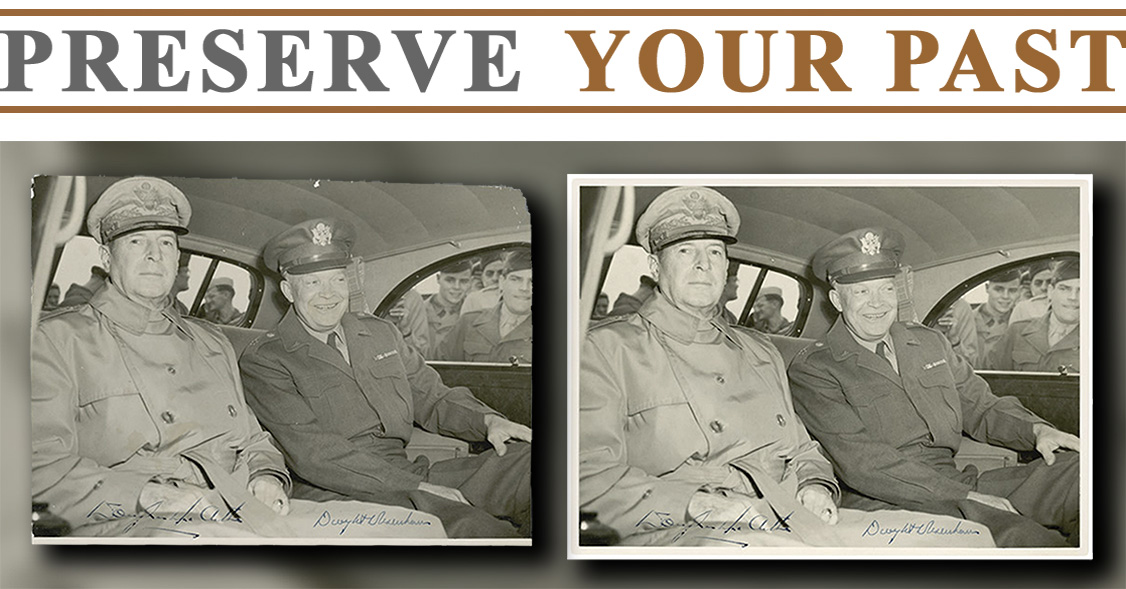
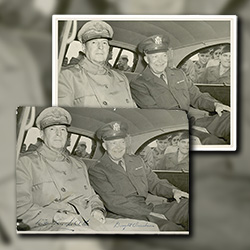
RESTORATION OF A RARE AUTOGRAPHED PHOTOGRAPH OF GENERAL MACARTHUR AND GENERAL EISENHOWER
Some photographs preserve a moment in time. Others seem to hold an entire chapter of history within their frame.
This exceptionally rare autographed photograph depicts two of the most important American military leaders of the Second World War: General Douglas MacArthur and General Dwight D. Eisenhower. The photograph was taken in Tokyo in May 1946, during Eisenhower's visit to Japan and his meeting with MacArthur, who was serving as Supreme Commander for the Allied Powers during the occupation of Japan.
Only months earlier, Japan had formally surrendered aboard the USS Missouri in Tokyo Bay on September 2, 1945, bringing the Second World War to its conclusion. MacArthur, who accepted the surrender on behalf of the Allied powers, subsequently assumed responsibility for the Allied occupation of Japan and the enormous task of overseeing the country's transition from wartime devastation toward reconstruction and reform.
Against this extraordinary historical backdrop, the photograph captures a meeting between two men whose careers had become inseparably linked with the history of the war. Eisenhower had commanded Allied forces in Europe and served as Supreme Commander of the Allied Expeditionary Force during the liberation of Western Europe. MacArthur, meanwhile, had directed major Allied operations in the Pacific and Southwest Pacific and became the central figure in the Allied occupation of Japan.
The photograph was taken by renowned World War II photographer Tom Shafer, whose work documented some of the defining events and personalities of the era. Shafer spent much of the war in the Pacific and photographed General MacArthur on numerous occasions, including during the general's historic return to the Philippines. A signed example of this photograph is documented as having been taken in Tokyo in May 1946, with the image subsequently appearing in newspapers in June of that year.
Over the decades, the signed photograph became much more than a historical image. It became a deeply personal family heirloom, an object that connected the family who preserved it with both the photographer who stood behind the camera and the extraordinary figures standing before it.
Recognizing the importance and fragility of the original, the Shafer family commissioned a faithful facsimile reproduction that would allow the image to be preserved and enjoyed without subjecting the historic signed photograph to unnecessary handling.
The restoration process began with a careful examination of the original photograph. As with many historic photographs that have survived for generations, the print had accumulated stains, discoloration, and other evidence of age. Damaged and missing areas had to be reconstructed with precision, while ensuring that the restored image remained faithful to the character and appearance of the original.
This type of historical photograph restoration requires more than simply removing visible damage. Every decision must be made with an awareness of the photograph's history. The goal is not to create a modern-looking image, but to recover the visual information that has been obscured by time while preserving the qualities that make the original photograph authentic.
Particular attention was therefore devoted to maintaining the subtle tonal characteristics of the historic print. The restoration carefully preserved the original appearance and color qualities of the photograph while reconstructing damaged areas and minimizing the visual distractions caused by age.
The autographs presented another especially delicate challenge. The signatures of General Douglas MacArthur and General Dwight D. Eisenhower are an essential part of the photograph's historical and collectible value. Their appearance had to be preserved with extraordinary care so that the finished facsimile would faithfully reproduce not only the photographic image but also the character and placement of the authentic signatures.
One of the more unusual aspects of this photo restoration and facsimile reproduction involved the lower border of the photograph. To recreate the print as faithfully as possible, the texture and color of the lower border were carefully extended around the image. This allowed the photograph to be returned to its original dimensions while maintaining the visual continuity of the historic print.
Such details may seem subtle, but they are essential when creating a high-quality facsimile of a rare historical photograph. The objective is not merely to reproduce the central image. The entire object, including its borders, tonal balance, surface characteristics, and distinctive details, must be considered as part of the original artifact.
Once the restoration was completed, the image was prepared for reproduction on museum-quality fine art giclée photographic paper. The paper was carefully selected to closely match the appearance, texture, and overall character of the original signed photograph.
The finished facsimile became far more than a simple copy. It became a bridge between history and memory. Within its frame are two legendary military leaders photographed during the uncertain period immediately following the Second World War, when the world was emerging from years of unprecedented destruction. General MacArthur was overseeing the Allied occupation of Japan, while the country itself was beginning the difficult process of reconstruction and transformation. The image therefore represents not only two extraordinary individuals, but also a pivotal moment between the end of one era and the beginning of another.
It also preserves the legacy of Tom Shafer, the photographer who stood behind the camera and captured this fleeting encounter. For the Shafer family, the restoration ensured that an exceptionally rare photograph, and the history embodied within it, could continue to be preserved for future generations. The facsimile protects the visual legacy of the original while allowing its remarkable story to remain accessible.
This is the deeper purpose of historical photo restoration: not simply to repair an old photograph, but to rescue the memories, people, and stories contained within it. In this case, the restoration preserved an image of two extraordinary military leaders, the signatures they left behind, and the work of a photographer who documented one of the defining periods of the twentieth century. A photograph that survived the passage of time was given a new life, ensuring that its history would not be forgotten.
In recognition of their sacrifice, service, and suffering, Sebastian Wintermute offers free photo restoration and digital archiving services to:
- WWII Combat Veterans of the Allied Forces
- Holocaust Survivors
- Victims of 9/11 and other terrorist atrocities
as well as their immediate families and direct descendants
|
|
|
|
|
|
|
|
|
|
|
|
|
|
|
|
|
|
|
|
|
|
|
|
|
|
|
|
|
|
|
|
|
|
|
|
|
|
|
|
|
|
|
|
|
|
|||||||||
| © 2026 Preserve Your Past | |||||||||
| By accessing this website you signify that you read, understood, and agreed to be bound by Terms of Services. If you do not agree to these terms, you are not permitted to use the Services. These Terms of Services have the same force and effect as an agreement in writing. |
|||||||||


