RESTORATION, PRESERVATION & ARCHIVING
MENU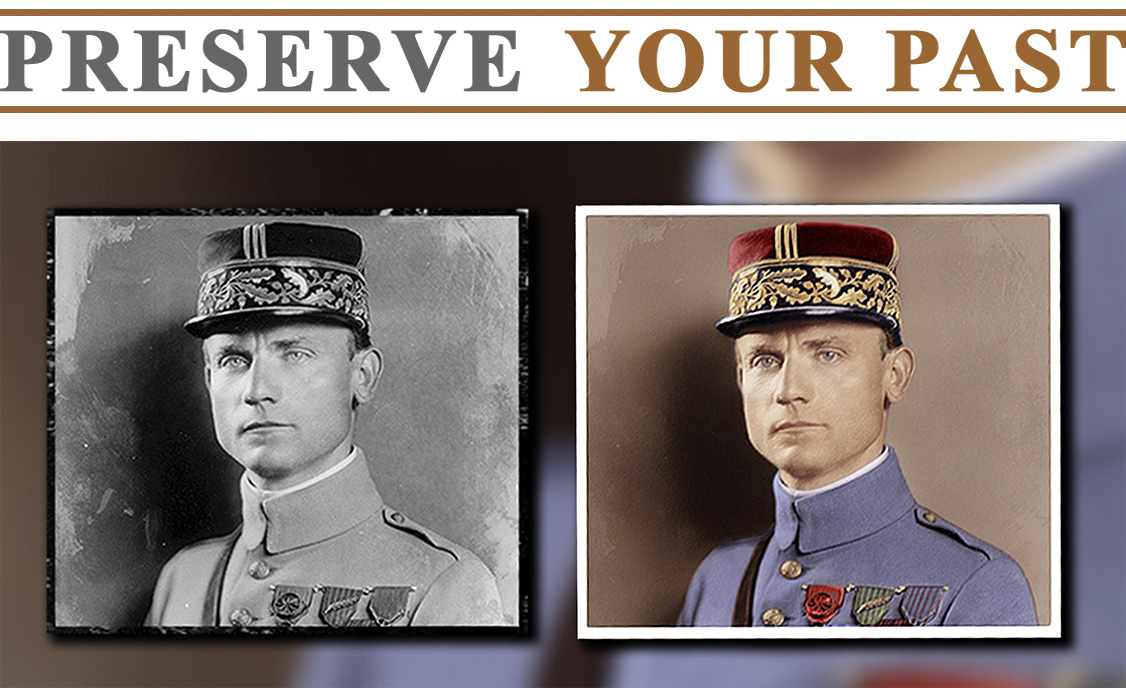
RESTORING AND COLORIZING A HISTORIC PORTRAIT
OF MILAN RASTISLAV ŠTEFÁNIK
Few stories begin as unexpectedly as this one.
We may never know how an original glass plate negative of the official portrait of Milan Rastislav Štefánik, one of the founders of Czechoslovakia, ended up forgotten in a shoebox in the damp, moldy basement of an old house on Long Island, New York. Regardless of the journey it took, I was honored to have the opportunity to restore one of the most historically significant portraits associated with one of Central Europe's greatest national heroes.
 Born in 1880, Milan Rastislav Štefánik was one of the most remarkable figures of the early twentieth century. A true Renaissance man, he lived by his personal motto: "To Believe, To Love, To Work." Throughout his extraordinary life, he distinguished himself as an astronomer, diplomat, politician, military leader, and pioneering aviator.
During the First World War, Štefánik became a general in the French Army and played a pivotal role in securing international support for the creation of an independent Czechoslovakia alongside Tomáš Garrigue Masaryk and Edvard Beneš. Following the collapse of the Austro-Hungarian Empire in 1918, he became the first Minister of War of the newly established Czechoslovak Republic.
Tragically, on May 4, 1919, while returning home from Italy aboard an Italian-built Caproni Ca.33 aircraft, Štefánik was killed when the aircraft crashed near Bratislava, an area of fighting between Czechoslovakia and the short lived but violent Hungarian Soviet Republic. His death, occurring at just thirty-eight years of age, remains one of the most discussed events in Czechoslovak history and has been the subject of numerous theories and historical investigations.
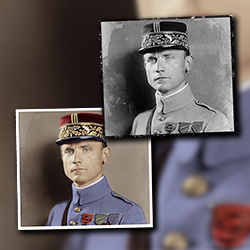
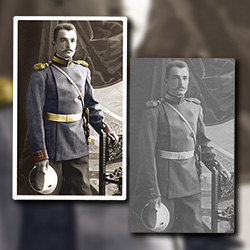
 The portrait featured here, depicting General Štefánik in full dress uniform adorned with his military decorations, including the prestigious Legion of Honour, became one of the most recognizable official portraits in Czechoslovak history. For decades it appeared on postcards, postage stamps, patriotic posters, books, commemorative medals, banknotes, coins, works of folk art, porcelain plates, and countless other tributes celebrating his life and legacy.
Because of its historical importance, the restoration was approached with the utmost care and respect for the original photograph.
The fragile glass plate negative was first thoroughly examined and then was scanned at high resolution to preserve every detail captured by the original photographer. Digital restoration focused solely on repairing damage caused by age, handling, dust, scratches, and deterioration of the glass plate while faithfully preserving the photograph's original character. No alterations were made that would compromise or distort the historical authenticity of the portrait.
After the restoration was completed, the portrait was meticulously hand colorized. Every effort was made to accurately reproduce the colors of General Štefánik's French military uniform, insignia, medals, and decorations. Historical references were carefully studied, and the color palette was verified through consultation with specialists in First World War military uniforms, heraldry, and military decorations. The result is a historically faithful color rendition that allows modern viewers to experience this iconic portrait much as it would have appeared during Štefánik's lifetime while fully respecting the integrity of the original photograph.
|
|
|
|
|
|
|
|
|
|
|
|
|
|
|
|
|
|
|
|
|
|
|
|
|
|
|
|
|
|
|
|
|
|
|
|
|
|
|
|
|
|
|
|
|
|
|||||||||
| © 2026 Preserve Your Past | |||||||||
| By accessing this website you signify that you read, understood, and agreed to be bound by Terms of Services. If you do not agree to these terms, you are not permitted to use the Services. These Terms of Services have the same force and effect as an agreement in writing. |
|||||||||


