RESTORATION, PRESERVATION & ARCHIVING
MENU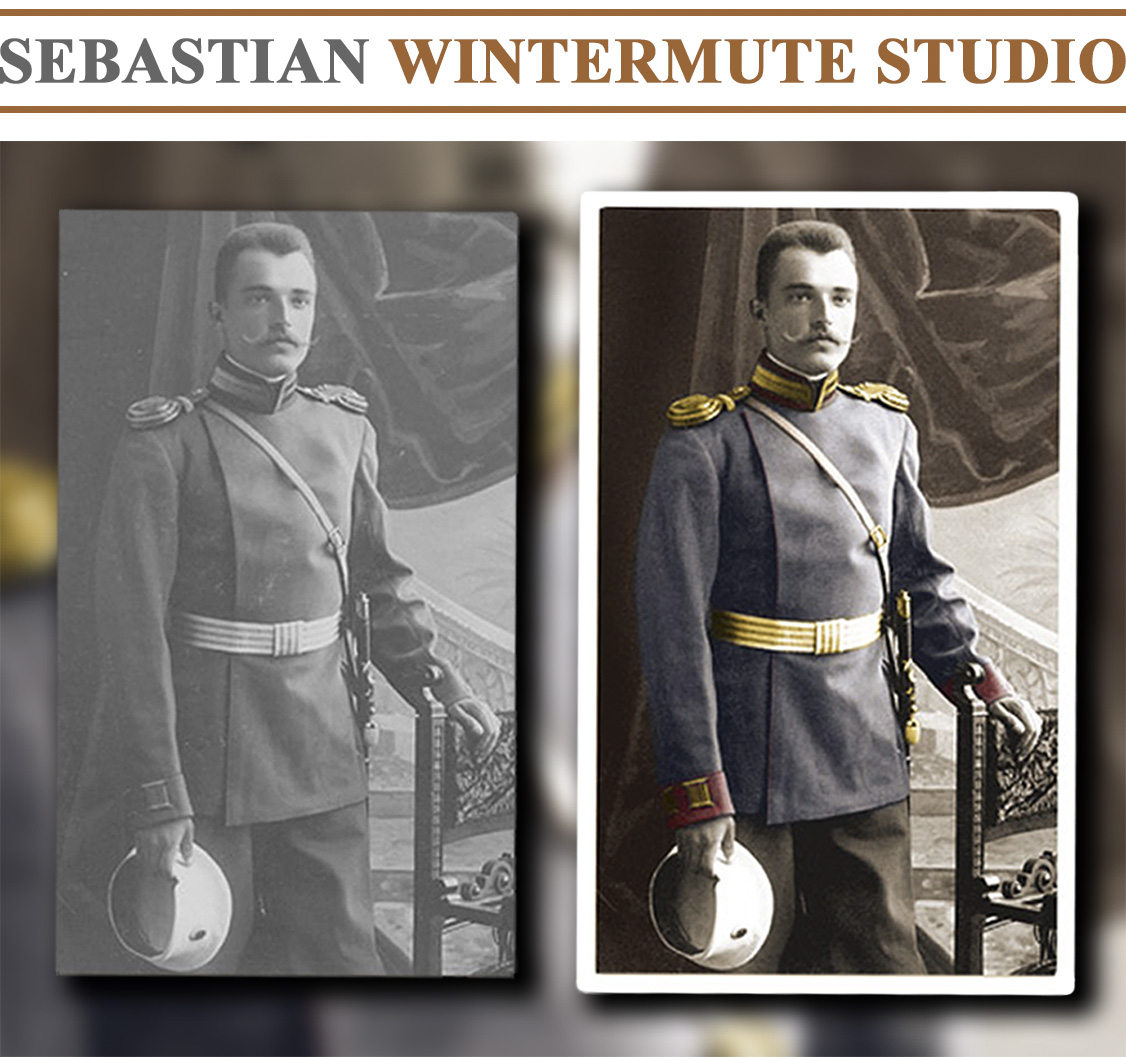
Restoration and Selective Colorization of a Russian Imperial Officer Portrait
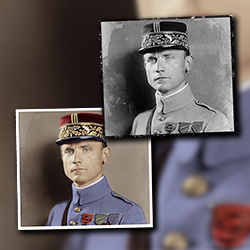
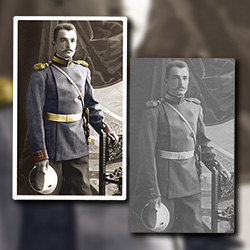
Taken in the late 19th or early 20th century, this studio portrait of a Russian Imperial officer dressed in formal military attire, wearing an ornate parade uniform with a blue tunic and white peaked cap. The officer is also shown wearing a Golden Sword of St. George, a highly prestigious military distinction associated with exceptional bravery and valor in combat.
The photograph is a compelling historical record of the Russian Imperial military and the traditions of its officer corps. Beyond the identity of the individual depicted, the portrait preserves important visual information about military dress, rank, ceremonial uniforms, and the system of honors that defined the Imperial Russian armed forces in the years before the end of the monarchy.
Before any restoration work began, the original photograph was carefully examined and professionally cleaned using appropriate conservation methods. Where necessary, the photographic object was stabilized to help protect it from further deterioration and to prepare it for safe handling and reproduction.
The preservation process is an essential part of any serious historical photo restoration project. A photograph such as this is more than an image; it is an original historical artifact. Its physical condition, surface characteristics, and signs of age are all part of its history and must be treated with care.
Once the photograph had been stabilized, a high-resolution digital scan was created. This provided a detailed working file from which the restoration could be performed with precision, minimizing the need to repeatedly handle the fragile original. The digital restoration process allowed scratches, imperfections, and other distractions caused by age to be addressed while preserving the essential character and detail of the original portrait.
The selective colorization of a historic military photograph requires considerably more than simply applying color to a black-and-white image. Accurate vintage photograph restoration often depends upon extensive research into the period, the individual depicted, and the specific visual details visible in the original photograph.
In this case, historical research was conducted to help determine the appropriate appearance of the officer's uniform, insignia, headgear, and military decorations. References relating to Imperial Russian military uniforms and ceremonial dress were carefully studied to guide the restoration.
Details such as the blue fabric of the tunic, the white cap, decorative elements, metallic trim, and the appearance of the officer's military honors were considered individually. Whenever possible, the goal was to remain faithful to the historical conventions of the period rather than introduce colors simply for aesthetic effect.
This research-driven approach is particularly important when restoring military portraits. Uniform colors and insignia can provide valuable information about an individual's regiment, branch of service, rank, or ceremonial status. Military decorations can also help tell the story of a person's service and achievements. For this reason, military photo restoration demands both technical skill and an understanding of historical context.
Among the most distinctive elements of the portrait is the officer's Golden Sword of St. George, a prestigious distinction associated with personal courage and bravery in battle. The award was part of the broader tradition of St. George honors within the Russian Imperial military, which recognized exceptional military service and valor. The presence of such an honor adds another layer of significance to the portrait. The photograph does not merely show an officer in uniform; it potentially records the appearance of a decorated military figure whose service was considered worthy of special recognition.
Careful attention was therefore given to the appearance of the sword and other elements of the officer's regalia during the restoration. The objective was not to embellish the portrait, but to make the historical details more legible and visually compelling while remaining faithful to the original photograph.
Following consultation with the client, a selective colorization approach was chosen. Rather than converting the entire portrait into a fully colorized image, color was thoughtfully introduced only into selected elements of the uniform and military regalia. The officer's face was intentionally left untouched in its original monochrome appearance. This artistic decision was central to the restoration. By preserving the face in black and white while introducing carefully researched color into the uniform, the finished image maintains a direct visual connection to the original photograph. The contrast between the monochrome portrait and the selectively colorized military attire draws attention to the historical details without overwhelming the character and atmosphere of the original image.
Selective colorization can be particularly effective when working with historically significant photographs. Used with restraint, it can reveal details that may have been difficult to appreciate in the original monochrome image while still respecting the photograph's age and visual identity. In this portrait, the colorization serves as a bridge between preservation and interpretation. The uniform and decorations become more visually immediate, while the officer's face remains rooted in the photographic tradition of the period.
The restoration of a historic photograph is not simply a matter of repairing damage, removing scratches, or adding color. At its best, historical photograph restoration is an interdisciplinary process that combines the precision of a conservator, the investigative approach of a historian, and the sensitivity of an artist. Every photograph presents its own challenges. Some require extensive digital repair. Others demand research into uniforms, architecture, family history, military insignia, or historical events. In many cases, the restoration process involves making careful decisions about what should be repaired, what should remain untouched, and how much interpretation is appropriate.
The same principle applies to colorization. Historical accuracy must always be balanced with artistic restraint. When the original photograph is the only surviving visual record of an individual, preserving its authenticity is paramount.
For this Russian Imperial officer portrait, the restoration was designed to respect the photograph's historical character while making its details more accessible to the modern viewer. The carefully researched colors of the uniform and military regalia provide a renewed sense of presence, while the untouched monochrome face retains the atmosphere and emotional immediacy of the original image.
Ultimately, every historic photograph carries a story. Sometimes that story is contained in the expression of a face; sometimes in the clothing, insignia, or objects surrounding the subject. Often, it is found in the subtle details that reveal when and where a photograph was made. Preserving those details requires more than technical expertise. It requires patience, historical research, artistic judgment, and respect for the original object.
Through careful photo restoration, historical research, and selective colorization, this portrait of a Russian Imperial officer has been given a renewed visual presence while retaining its connection to the past. The result is not simply a restored photograph, but a carefully preserved piece of history, one that allows a modern audience to look more closely at the uniform, the military traditions, and the individual who stood before the camera more than a century ago.
|
|
|
|
|
|
|
|
|
|
|
|
|
|
|
|
|
|
|
|
|
|
|
|
|
|
|
|
|
|
|
|
|
|
|
|
|
|
|
|
|
|
|
|
|
|
|||||||||
| © 2026 Preserve Your Past | |||||||||
| By accessing this website you signify that you read, understood, and agreed to be bound by Terms of Services. If you do not agree to these terms, you are not permitted to use the Services. These Terms of Services have the same force and effect as an agreement in writing. |
|||||||||


