RESTORATION, PRESERVATION & ARCHIVING
MENU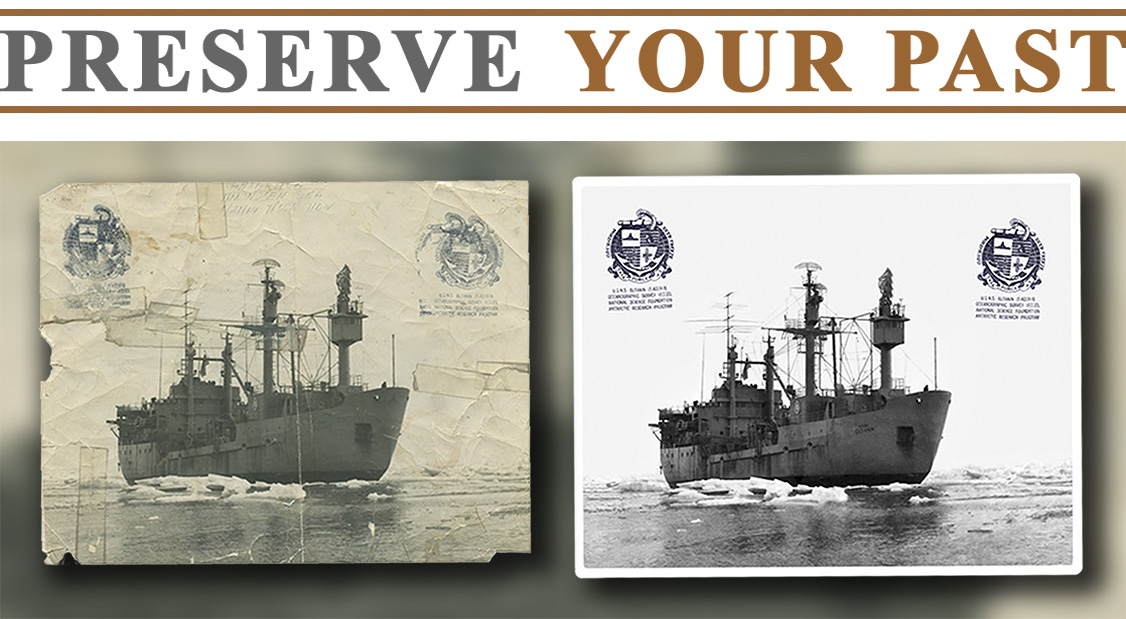
Restoration of a USNS Eltanin Antarctic Expedition Photograph
Between 1962 and 1972, USNS Eltanin completed 52 Antarctic research voyages, sailing more than 400,000 miles while surveying over 80 percent of the Southern Ocean. The scientific data collected aboard USNS Eltaninsignificantly advanced the fields of oceanography, marine biology, geology, geophysics, and climatology, making the vessel one of the most important Antarctic research ships of its era.
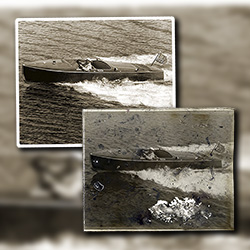
 Taken during one of these historic expeditions, this original photograph of the USNS Eltanin, bearing the imprints of the expedition's official emblem, had suffered extensive deterioration over the decades. The print exhibited severe chemical discoloration, numerous tears and creases, missing sections, and damage caused by an earlier repair attempt using clear adhesive tape, a common but highly destructive practice that often leaves permanent stains and residue on historic photographs.
The restoration began with meticulous conservation work to remove accumulated dust, surface debris, adhesive residue, and tape stains without causing further damage to the original print. Once stabilized, the photograph was captured in a high-resolution digital scan, providing the foundation for an extensive digital restoration. Tears, missing areas, scratches, creases, and discoloration were painstakingly repaired while preserving the photograph's authentic detail and tonal range. The expedition's official emblem was also carefully cleaned, and ink smudges that obscured portions of the image were removed.
Sebastian Wintermute approaches every restoration with the goal of preserving as much historical authenticity as possible. Original annotations, handwritten notes, and signs of age are normally retained whenever they contribute to the historical significance of an artifact. In this case, however, the restoration was guided by the client's request for a pristine presentation. At the client's direction, the handwritten notations and ink smudges were digitally removed, resulting in a clean, exhibition-quality image while leaving the original photograph physically unaltered.
After the restoration was completed, a museum-quality reproduction was printed on archival fine art paper carefully selected to match the size and appearance of the original photograph, ensuring that this remarkable record of one of the twentieth century's most significant Antarctic research vessels can be appreciated and preserved for generations to come.
|
|
|
|

|
|
|
|
|
|
|
|
|
|
|
|
|
|
|
|
|
|
|
|
|
|

|
|
|
|

|
|
|
|
|
|
|
|
|
|
|
|
|
|

|
|
|||||||||
| © 2026 Preserve Your Past | |||||||||
| By accessing this website you signify that you read, understood, and agreed to be bound by Terms of Services. If you do not agree to these terms, you are not permitted to use the Services. These Terms of Services have the same force and effect as an agreement in writing. |
|||||||||


