RESTORATION, PRESERVATION & ARCHIVING
MENU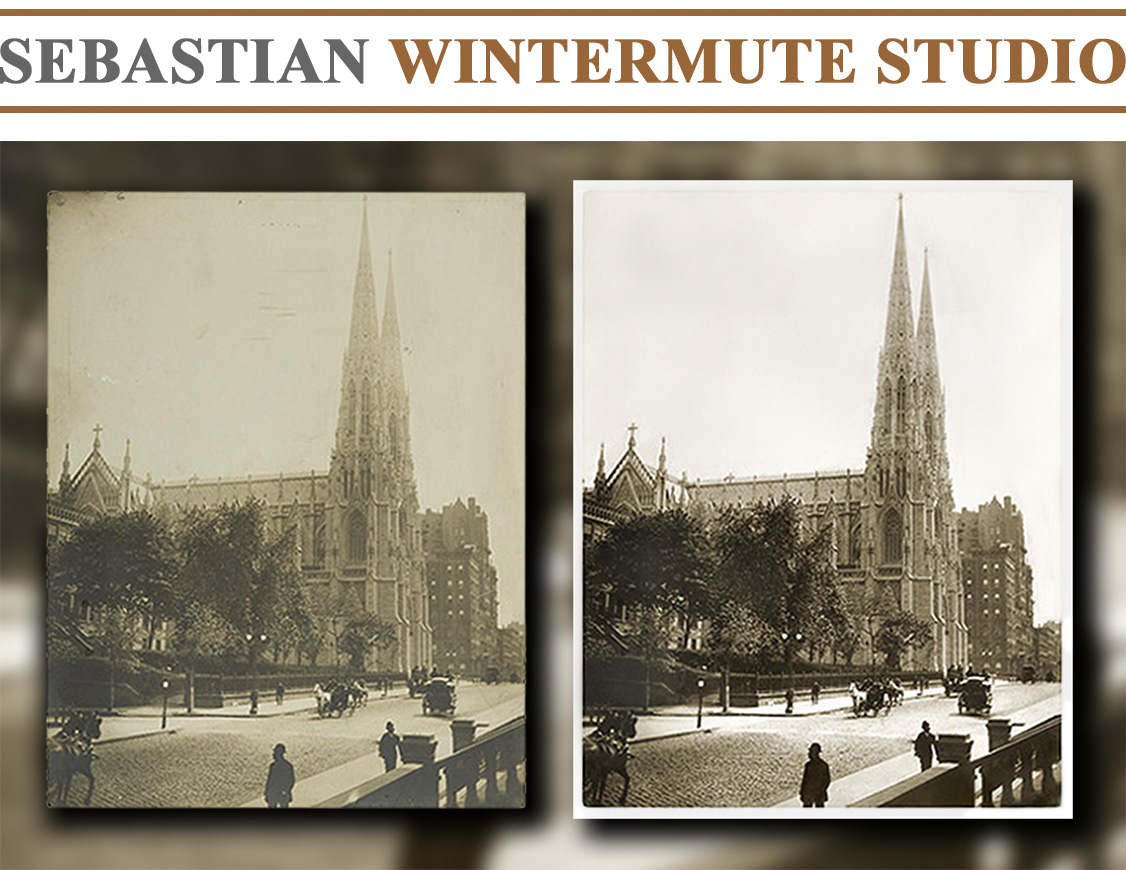
RESTORATION OF A HISTORIC PHOTOGRAPH OF ST. PATRICK'S CATHEDRAL ON FIFTH AVENUE
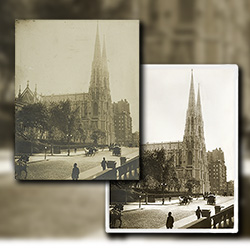
St. Patrick's Cathedral is one of New York City's most recognizable landmarks, but this rare photograph captures it during a remarkably different era, when Fifth Avenue was still a quiet residential boulevard, an afternoon stroll was one of the city's favorite pastimes and any place above Central Park was jokingly considered to be "The Upstate".
The construction of St. Patrick's Cathedral reflected both the extraordinary growth of New York City and the determination of its Irish Catholic community. During the first half of the nineteenth century, hundreds of thousands of Irish immigrants arrived in New York, many fleeing the Great Famine of the 1840s. Although they played a vital role in building the city, they faced widespread prejudice and discrimination. Employers frequently displayed the infamous "No Irish Need Apply" signs, and anti-Catholic sentiment was common throughout American society.
The city's original Catholic cathedral, Old St. Patrick's Cathedral on Mulberry Street, had become too small for the rapidly growing congregation. As New York expanded northward, Archbishop John Hughes envisioned a magnificent new cathedral that would stand not in the crowded immigrant neighborhoods of Lower Manhattan, but in what was then the northern edge of the city. Construction of St. Patrick's Cathedral began in 1858 and, despite delays caused by the Civil War, was completed in 1878. The Gothic Revival masterpiece became a lasting symbol of the resilience, faith, and growing influence of New York's Irish Catholic community.
This photograph was preserved for many decades as part of an institutional archive documenting New York City's architectural and cultural history. Although it had been carefully stored under archival conditions, the natural aging of the photographic materials caused the image to fade significantly over time. By the time it arrived at the studio, much of its fine detail had become difficult, or even impossible, to discern with the naked eye.
The original photograph was first carefully examined and gently cleaned to remove accumulated dust and surface grime before being digitized using a high-resolution archival scanning process designed to capture every surviving detail. The resulting digital master file served as the foundation for a meticulous restoration. Faded architectural features, subtle tonal variations, and delicate elements, including the telegraph wires stretching above Fifth Avenue, were carefully recovered. Overall contrast and depth were restored to better reflect the original photographic print, while minor abrasions, stains, and later additions, such as an archival catalog number written in ink in the upper left corner, were digitally removed. The completed restoration faithfully preserves both the historical character of the original photograph and the remarkable appearance of St. Patrick's Cathedral during one of the most transformative periods in New York City's history.
|
|
|
|

|
|
|
|
|

|

|
|
|
|
|
|
|
|
|
|
|
|
|
|
|
|
|
|
|
|
|
|
|

|
|
|
|
|
|
|

|
|

|
|

|
|
|||||||||
| © 2026 Preserve Your Past | |||||||||
| By accessing this website you signify that you read, understood, and agreed to be bound by Terms of Services. If you do not agree to these terms, you are not permitted to use the Services. These Terms of Services have the same force and effect as an agreement in writing. |
|||||||||


